 {# Overlay logo in the middle of the banner, no layout shift #}





A consultation-stage proposal would require every team to keep a homegrown U-20 or U-21 player on the field at all times
The Biggest Lineup Change Since the Introduction of Substitutes Is Being Considered by FIFA



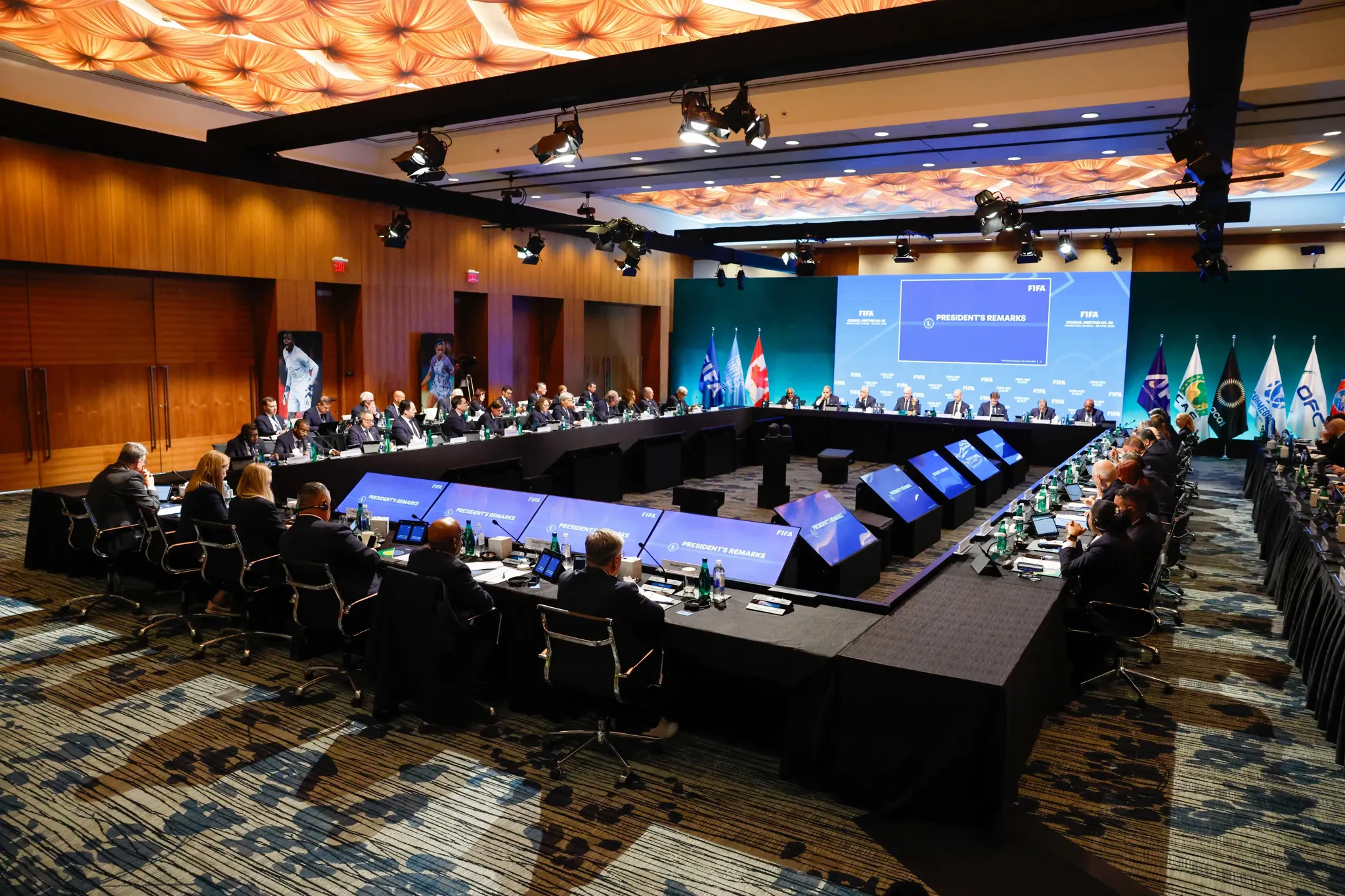
On April 29, 2026, FIFA advanced a proposal requiring teams to keep a homegrown U-20 or U-21 player on the field at all times. The requirement is designed to ensure that clubs not only develop young players, but move them into the first team and keep them in matchday lineups rather than treating them as unused depth.
Teams across top leagues routinely carry young players without relying on them in matches, particularly when protecting results or managing late substitutions. This proposal removes that separation by making at least one young player part of every lineup decision, including the moments when coaches typically turn to experience.
That shift creates a direct pathway from academy to first-team usage, because clubs must produce or acquire players who can be included consistently rather than stored as long-term projects. It also introduces a constraint, since every substitution must maintain compliance, and limits when a coach can remove a qualifying player. The FIFA Council also unanimously approved a consultation process with all relevant stakeholders for a regulatory obligation that senior club teams are obliged to always have at least one homegrown player from the U-20 or U-21 category on the field of play, and for the proposal to be submitted to the FIFA Council in the next year. FIFA Council FIFA Council Release, April, 2026
Source: https://www.inside.fifa.com/media-releases/council-increases-record-financial-distribution-member-associations-world-cup-2026
The proposal remains in consultation. There are no trials, pilot competitions, or implementation framework in place. FIFA is expected to revisit it in 2027 after consultation with leagues, clubs, and player groups. The timeline gives those groups a period to review the proposal, raise concerns, and suggest changes before any decision is made.
The proposal does not define what qualifies as a “homegrown” player, leaving a key part of the rule unresolved. It remains unclear whether eligibility would require players to be developed within a club’s academy or simply trained within the same country, regardless of which club developed them.
If FIFA defines a homegrown player as one developed within a club’s academy, eligibility would be limited to players produced internally, requiring teams to rely on their own development pathway to meet the requirement. Teams without a consistent pipeline would need to invest in their academies or promote younger players earlier to maintain compliance.
If FIFA allows a broader definition based on players trained within the same country, clubs could meet the requirement by signing eligible U-21 players developed elsewhere. That approach allows teams to satisfy the rule through recruitment rather than internal development.
The U-20 or U-21 requirement creates a constant turnover in eligibility, since players age out of the category and must be replaced. A player who qualifies one season may not qualify the next, requiring clubs to maintain multiple eligible options rather than relying on a few players.
What Lineup Constraints Would Actually Look Like in a Match
The requirement effectively forces teams to include at least one U-20 or U-21 player in the starting lineup and carry another on the bench to ensure coverage. A team must be able to replace its qualifying player at any point in the match without falling out of compliance.
A team risks falling out of compliance if it substitutes its starting U-20 or U-21 player without bringing on another eligible player. The same restriction then applies to the replacement. If that player needs to come off, he also has to be replaced by another qualifying player.
This means the problem doesn’t go away after one substitution. Each eligible player can only be removed if another is ready to replace him, which limits how often a team can make changes. As a result, teams may keep their starting U-20 player on the field longer than planned or avoid substituting him altogether unless they have multiple eligible options available.
If the only U-20 or U-21 player has to come off due to injury or being sent off, the team must immediately introduce another eligible player from the bench. That replacement may not play the same position, which can force the team to adjust its shape. A team could be required to bring on a U-20 striker to replace an injured fullback, leading to a formation change or multiple positional shifts to maintain compliance.
FIFA has not defined how the potential rule would be enforced if a team falls out of compliance, leaving open how violations would be handled during a match.
How MLS would have to adapt immediately
Major League Soccer already allows clubs to sign Homegrown Players, but it does not require them to use those players in matches. A rule requiring a U-20 or U-21 player on the field at all times would turn that pathway into a lineup obligation.
Roster construction would become more restrictive. MLS clubs operate under roster limits and salary constraints, so carrying multiple eligible players is not just a development decision, but a trade-off against other positions.
Clubs with established academies would have an immediate advantage, since they already produce players who can be included in matchday lineups. Teams without that pipeline would need to rely on signing domestic U-21 players to meet the requirement.
The rule would also affect how MLS clubs use international roster spots. Teams built around imported players would need to reserve lineup space for a qualifying domestic player, which could change how squads are assembled.
The Reality Check: Will this rule be Implemented
This remains a proposal and is not guaranteed to be implemented. The current consultation phase runs through 2027, during which FIFA is gathering input from leagues, clubs, and player groups.
After that process, FIFA could present a revised version of the proposal, introduce trial competitions, or move toward a formal decision. Key details, including how “homegrown” is defined and how the rule would be enforced, are expected to be addressed during that stage.
The proposal is plausible because it aligns with priorities FIFA has emphasized in recent years, including youth development, pathway access, and competitive balance. Clubs may already invest in academies, but those players do not always progress into first-team lineups. Requiring a U-20 or U-21 player to remain on the field would extend that pathway into matches, ensuring young players are not only developed, but used. It could also reduce reliance on established veterans by requiring teams to allocate at least one position to a younger player.
The difficulty lies in how the rule affects the match itself. Every substitution would have to maintain compliance, which limits when and how changes can be made. An injury, substitution, or positional mismatch could force a team to reshape its lineup around the requirement rather than the game. Differences in academy strength across leagues also mean the rule would not affect all teams equally, making a single global standard difficult to apply.
Eligibility at Atlanta United: A Rotating Tactical Puzzle
We’ve seen Jay Fortune move from a homegrown prospect to a trusted engine in the midfield, but under these potential new rules, players like him wouldn’t just be trusted - they would be required.
The current homegrown group in Atlanta perfectly illustrates how complex this becomes when you stop looking at a roster and start looking at a clock.
The Bench Insurance At 18, Adyn Torres and Santiago Pita are more than just long-term midfield projects. They become essential safety nets. If your starting XI features a teenager, you almost have to keep one of these two on the bench. Otherwise, an injury in the 20th minute doesn’t just cost you a sub; it forces you into a tactical crisis to stay legal.
The Defensive Premium Dominik Chong-Qui carries a unique kind of value here. Reliable young defenders are gold under this proposal. If you can satisfy the youth requirement with a center-back or fullback, you don’t have to worry about burning a high-leverage attacking substitution just to keep a “compliant” player on the pitch.
The Ticking Clock: Luke Brennan is the cautionary tale of the age cutoff. He offers immediate utility today, but the countdown is on. As he nears 22, the club faces a brutal choice: has he improved enough to warrant a “senior” spot on his own merit, or is he replaced by a younger, “compliant” version?
The Goalkeeper “Cheat Code”: Jayden Hibbert raises the most fascinating question of all. If a homegrown goalkeeper qualifies, a club could theoretically satisfy the rule for a full 90 minutes with one player who rarely needs subbing. It frees up the rest of the 10 outfield spots for veteran stars.
The Value Shift: This rule would fundamentally change the transfer market. Eligible U-21s like Noah Cobb or Efrain Morales would suddenly see their “ask” price skyrocket because they provide both talent and regulatory relief to a buyer. Conversely, we might see a “Value Dip” for players who just turned 22. Once they lose that “compliance” status, they have to prove they are twice as good as the teenager replacing them just to stay in the lineup.
The Retention Dilemma: In the past, you’d loan a young player out to get them minutes. Now, you might be tempted to keep them on the bench as a “tactical key” just in case your starter goes down. It’s a delicate balance: do you do what’s best for the player’s European ambitions, or what’s best for the club’s domestic compliance?
The Decision Hidden Inside the Proposal
The requirement forces clubs to evaluate young players based on whether they can stay on the field without limiting how the team uses its substitutions. A qualifying player must be able to handle different match situations while changes are made around him.
The proposal does not prioritize the most talented young player. It prioritizes the player a coach is willing to leave on the field as the match evolves.
A second eligible player on the bench faces a different risk. Instead of developing through playing time, he may be held in reserve to maintain compliance, used only when required. That role can leave him under-used, limiting his development and weakening the rule’s intended impact.


Comments
Comments and reactions are powered by GitHub Discussions. A GitHub account is required to comment, reply, or react. You will be asked to authorize Giscus to post through your GitHub account. Comments are screened automatically. Personal attacks, discriminatory language, threats, spam, and comments unrelated to the article will be hidden or removed.